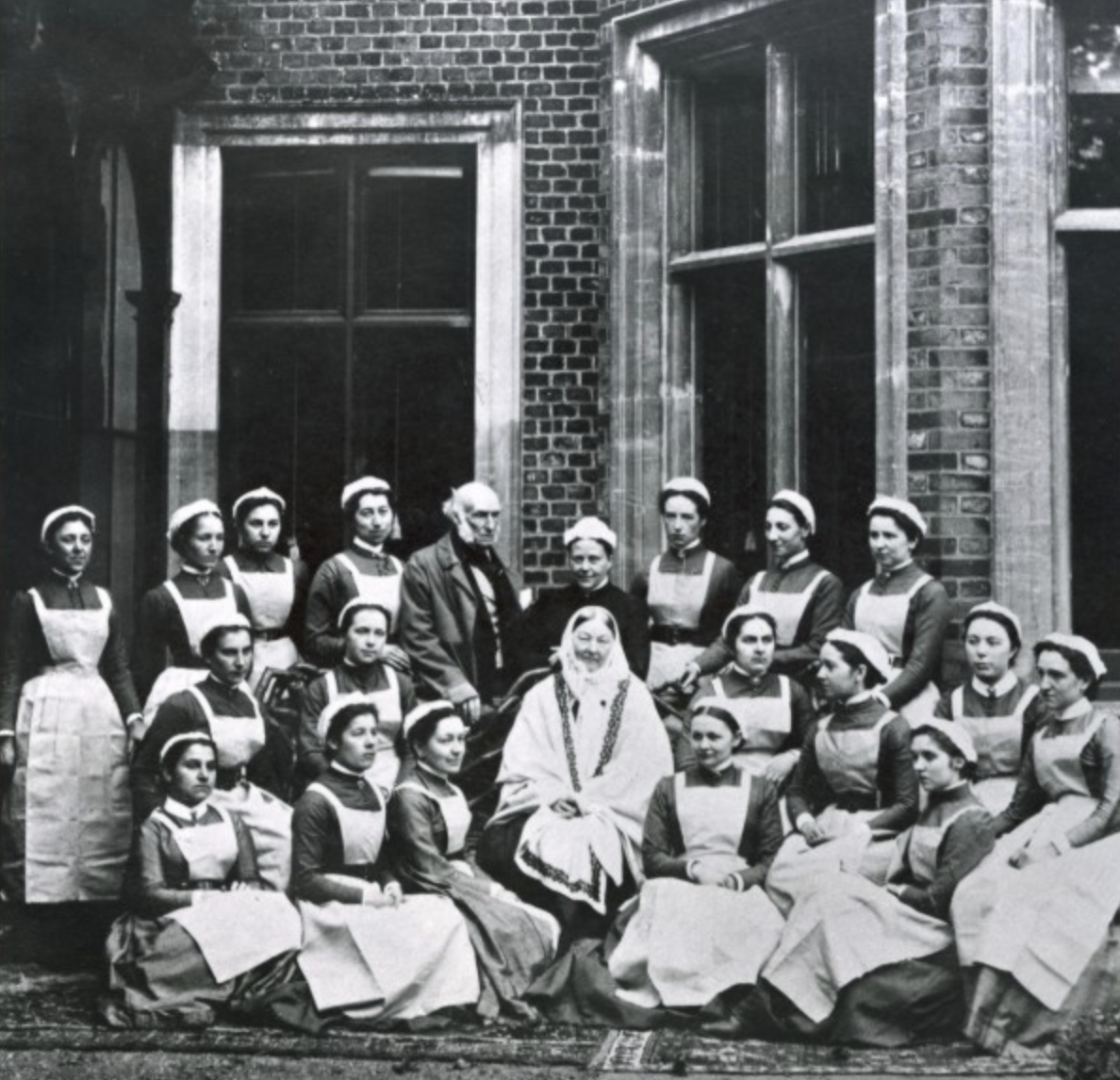
Our group selected the Nurse Training Register: Private Record (1856–1888) as a starting point to explore whether nursing has always been a viable “pathway” for women. Especially women from working-class and immigrant backgrounds who aspire to achieve social mobility and identity. This register documents nurse training practices at an infirmary in Leeds during the Victorian period, including attendance records, advancements, and reasons for leaving. As such, it serves as a valuable primary source for examining the institutional structure and dynamics of the nursing profession in the nineteenth century.
The Crimean War’s intensified demand for medical care created new medical field opportunities for individuals, causing women to be the main participants in nursing (National Army Museum, 2025)1. Middle-class women, motivated by religious faith entered the nursing field as “volunteers”. Women from working-class or marginalized backgrounds were driven by economic necessity or the desire for social and racial recognition (Moore, 2024)2. Among them, Florence Nightingale’s contributions during the Crimean War and her postwar nurse training initiatives, such as setting up the Nightingale Training School in London, laid the foundations for modern nursing practice and are widely celebrated (National Army Museum, 2025)3.
The Nurse Training Register was created on the basis. It is about the little-known experiences of working-class and marginalized women in nurse training schools. The register reveals a diversity of entry backgrounds, underscoring that nursing was not solely shaped by the ideals of middle-class reformers like Nightingale. Rather, it was sustained by a foundational workforce of many anonymous nurses, such as poor women, immigrant women, and religious minorities. Their participation shaped the daily practice of nursing. Their social mobility, both before and after entering, allows us to reflect on the complex intersections of class, gender, and race in the Victorian era.
Various internal tensions within the UK nursing that emerged during its development remain unresolved today. As in Crimean War, we found the Sisters of Mercy left because of the opposite religious tendencies (Paradis et al., 2017)4. A woman Mary Seacole was rejected on racial grounds (Ellis, 2009)5. Issues in the modern nursing field may involve gender, race, job vacancies and many other aspects. , which reach beyond economically steered assertions of control and power plays are more relevant than ever.
In terms of gender representation, men are still a “markedly underrepresented group” in nursing (Nursing Times, 2008)6, and nursing continues to be widely perceived as “women’s work” (Woo et al., 2022)7. In research on male nurse, there is a “glass escalator”, which refers to the fact that male nurses may benefit from faster career advancement despite being a minority group in the nursing profession (Williams, p.256)8. However, such individual advantages may further obscure the profession’s underlying structural inequalities. Some scholars argue that more attention should be given to strategies aimed at “empowering all nurses” rather than benefiting a select few (Kearns & Mahon, 2021, p.3)9.
Since 2010, staff shortages in the NHS have become increasingly severe and are one of the most pressing challenges in the UK healthcare system (The Guardian, 2022)10. Following the 2016 Brexit referendum, the number of healthcare professionals from EU countries declined sharply (McCarey et al., 2022)11. The COVID-19 pandemic further exposed and intensified these structural problems. By 2023, unfilled positions in the NHS had reached approximately 12% of the total workforce (Matt Farrah, 2024)12.
In summary, while the NHS is heavily reliant on internationally trained nurses, institutional barriers continue to hinder their full participation (Palmer et al., 2021)13. This mismatch between high labour demand and limited systemic support highlights the structural constraints placed on migrant workers in the nursing profession. As international students, we became increasingly aware—through the course of this project—that the selective mechanisms which affect foreign-born women in nursing are not confined to policy documents. Rather, they manifest in lived experiences across education, training, and cultural navigation. This recognition reminds us that the core question is not only whether nursing remains a “viable pathway” or who is permitted to walk that path, but also to find out what is “nursing a way out of”.
Visualisation, OCR recognition, and audio analysis each offer valuable digital methods but also have notable limitations. Visualisation enables complex data representation, enhancing comprehension and communication (Chen et al., 2008)14, yet it risks oversimplification or misinterpretation if poorly designed. Optical Character Recognition (OCR) technologies significantly improve text digitisation efficiency, but accuracy issues persist, especially with handwriting in the Nurse Training Register (Smith, 2007)15.
In our project, OCR errors occasionally required manual correction. Audio-based methods, such as using recorded interviews, allow researchers to capture rich, contextual insights and lead audience to focus on the content of sound (Gershon, 2013)16. However, how to transcribe accurately (Gubrium and Holstein, 2012)17 and the ethics on using the soundtracks (Cychosz et al., 2020)18 are challenges for us.
- 1 National Army Museum, 2025. Crimean War. [Online]. [Accessed 27 April 2025]. Available from: https://www.nam.ac.uk/explore/crimean-war
- 2 Moore, D., 2024. Visions of the East: Orientalism and Imperialism in the Memoirs of Crimean War Nurses. Women’s Writing: The Elizabethan to Victorian Period. 31(4), pp.552–569.
- 3 National Army Museum, 2025. Florence Nightingale: The Lady with the Lamp. [Online]. [Accessed 27 April 2025]. Available from: https://www.nam.ac.uk/explore/florence-nightingale-lady-lamp
- 4 Paradis, M.R., Hart, E.M. and O’Brien, M.J., 2017. The Sisters of Mercy in the Crimean War: Lessons for Catholic Health Care. The Linacre Quarterly. 84(1), pp.29–43.
- 5 Ellis, H., 2009. Mary Seacole: Self Taught Nurse and Heroine of the Crimean War. Journal of Perioperative Practice. 19(9), pp.304–305.
- 6 Nursing Times, 2008. Why are there so few men in nursing? [Online]. [Accessed 27 April 2025]. Available from: https://www.nursingtimes.net/archive/why-are-there-so-few-men-in-nursing-03-03-2008/
- 7 Woo, B.F.Y., Goh, Y.S. and Zhou, W., 2022. Understanding the gender gap in advanced practice nursing: a qualitative study. Journal of Nursing Management. 30(8), pp.4480–4490.
- 8 Williams, C.L., 1992. The Glass Escalator: Hidden Advantages for Men in the “Female” Professions. Social Problems. [Online]. 39(3), pp.253–267. [Accessed 13 Apr. 2025]. Available from: https://doi.org/10.2307/3096961
- 9 Kearns, T. and Mahon, P., 2021. How to attain gender equality in nursing—an essay. BMJ, 373. [Online]. [Accessed 13 Apr 2025]. Available from: https://doi.org/10.1136/bmj.n1232
- 10 The Guardian, 2022. NHS vacancies in England at staggering new high as almost 10% of posts empty. [Online]. [Accessed 13 April 2025]. Available from: https://www.theguardian.com/society/2022/sep/01/nhs-vacancies-in-england-at-staggering-new-high-as-almost-10-of-posts-empty
- 11 McCarey, M., Dayan, M., Jarman, H., Hervey, T., Fahy, N., Bristow, D. and Greer, S.L., 2022. Health and Brexit: six years on. London: Nuffield Trust.
- 12 Matt Farrah, 2024. Stats and facts: UK nursing, social care and healthcare. [Online]. [Accessed 13 April 2025]. Available from: https://www.nurses.co.uk/blog/stats-and-facts-uk-nursing-social-care-and-healthcare/
- 13 Palmer, B., Leone, C. and Appleby, J., 2021. Recruitment of nurses from overseas. [Online]. London: The Nuffield Trust. [Accessed 13 April 2025]. Available from: https://www.nuffieldtrust.org.uk/sites/default/files/2021‐10/recruitment‐of‐nurses‐drivers‐web.pdf
- 14 Chen, C. H., Härdle, W., Unwin, A., and Friendly, M., 2008. A brief history of data visualization. Handbook of data visualization, pp.15–56.
- 15 Smith, R., 2007. An overview of the Tesseract OCR engine. In: Proceedings of the Ninth International Conference on Document Analysis and Recognition (ICDAR 2007), 23–26 September 2007, Curitiba, Brazil. Piscataway, NJ: IEEE, Vol. 2, pp.629–633.
- 16 Gershon, W.S., 2013. Vibrational affect: Sound theory and practice in qualitative research. Cultural Studies? Critical Methodologies, 13(4), pp.257–262.
- 17 Gubrium, J.F. and Holstein, J.A., 2012. Narrative practice and the transformation of interview subjectivity. In: Gubrium, J.F., Holstein, J.A., Marvasti, A.B. and McKinney, K.D., eds. The SAGE handbook of interview research: The complexity of the craft. Thousand Oaks, CA: SAGE Publications, pp.27–44.
- 18 Cychosz, M., Romeo, R., Soderstrom, M., Scaff, C., Ganek, H., Cristia, A. and Weisleder, A., 2020. Longform recordings of everyday life: Ethics for best practices. Behavior Research Methods, 52, pp.1951–1969.